
OUR WORK
NEXT-GENERATION NEUROINTERFACES
We develop advanced biomaterials and conductive architectures to bridge biological neural tissue and electronic systems. By minimizing inflammatory responses and maximizing signal fidelity, our next-generation interfaces aim to enable stable, long-term neural recording and stimulation for translational neurotechnologies.
ORGANOID-ELECTRODE ARCHITECTURES
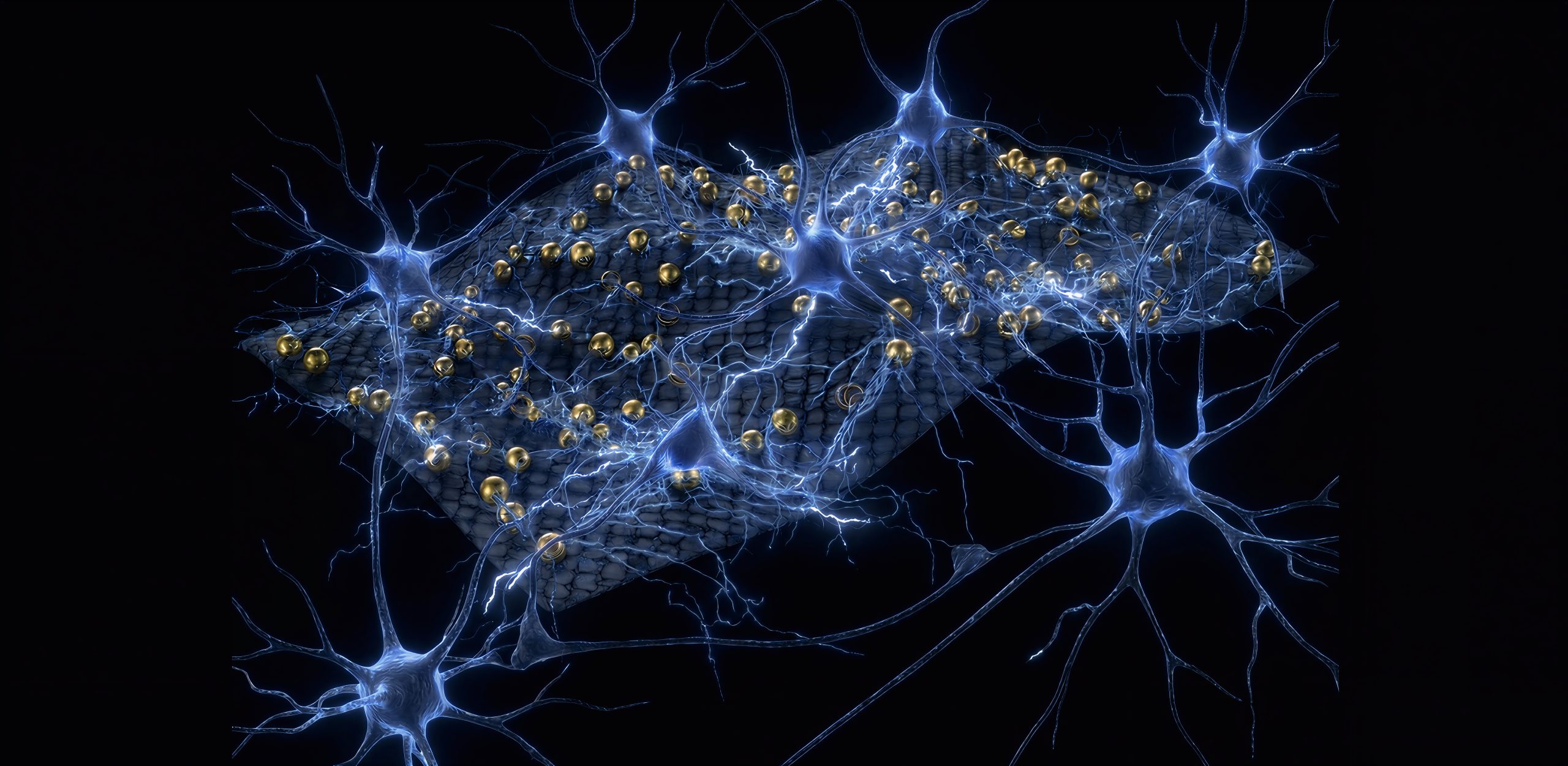
We integrate 3D neural organoids with high-performance microelectrode platforms to create physiologically relevant in vitro systems. These hybrid bioelectronic platforms allow real-time electrophysiological monitoring and provide predictive tools for disease modeling, drug evaluation, and device validation.
ADVANCED MATERIALS
FOR BIOELECTRONICS
We investigate functional materials that enable the next generation of implantable and biointegrated devices. Our work explores conductive polymers such as PEDOT:PSS, two-dimensional materials including MXenes, and porous frameworks such as MOFs for sensing, stimulation, and biointerface engineering.
WIRELESS NEUROMODULATION
SYSTEMS
We design implantable and minimally invasive platforms for targeted neural stimulation. By integrating next-gen stimuli-responsive materials, soft electronics, and adaptive geometries, we aim to enable power-efficient, wire-free neuromodulation strategies for rehabilitation and precision therapy.
IMPLANTABLE BIOELECTRONIC
THERAPEUTICS
We develop smart implantable systems that combine sensing and stimulation within a unified architecture. These platforms are engineered to interact dynamically with biological environments, paving the way for closed-loop therapies in neurological and metabolic disorders.
MINIMALLY INVASIVE
AND NON-INVASIVE SENSING
We develop advanced sensing platforms for minimally invasive and non-invasive biomedical monitoring. These technologies are designed to detect physiological signals and biochemical markers with high sensitivity and stability in complex biological environments.
OUR RESEARCH PHILOSOPHY
Our work integrates advanced biomaterials, intelligent engineering design, and translational device development to restore biological function. We move from material discovery to implantable system architecture with a clear focus on clinical relevance. Each platform is engineered to establish stable, long-term interaction between living tissue and electronic systems.
WHY NEURAL INTERFACES ?
Neurological disorders affect millions worldwide and require precise modulation of complex neural networks. Neural interfaces enable direct communication between engineered devices and the nervous system and allow high-fidelity recording and stimulation. By improving stability, selectivity, and biocompatibility, we aim to advance long-term neuromodulation strategies.
WHY BIOELECTRONIC THERAPEUTICS?
Future therapies increasingly depend on dynamic regulation of biological signals rather than systemic drug administration. Bioelectronic therapeutics integrate sensing and stimulation within unified implantable architectures and offer adaptive, energy-efficient control of neural function. These systems redefine how engineering translates into precision clinical intervention.
NEUROSTATS
PEOPLE WORLDWIDE AFFECTED BY NEUROLOGICAL DISORDERS
BIOELECTRONIC MEDICINE MARKET SIZE
ANNUAL NEUROMODULATION DEVICE MARKET GROWTH
DRUG CANDIDATES FAIL BEFORE APPROVAL
ANNUAL ORGAN-ON-CHIP MARKET GROWTH
“Braın-computer ınterface (BCI) ımplant market to expand from USD 351.3 mıllıon ın 2025 to USD 684.1 mıllıon by 2030, addıng USD 332.8 mıllıon amıd FDA trıals for paralysıs.”
Future market insight Inc, 2025.
“Non-ınvasıve braın stımulatıon systems (TMS/tDCS), valued at USD 1.12 bıllıon ın 2024, forecasted to reach USD 2.03 bıllıon by 2032 at 6.5% CAGR for psychıatrıc therapıes.”
ReAnIn, 2026
“Deep braın stımulatıon (DBS) market, at USD 1.66 bıllıon now, set to grow at 10.4% CAGR to 2033, wıth Parkınson's capturıng 61.8% share amıd surging cases worldwıde.”
Market Data Forecast, 2025.
“Implantable neurostımulators market to exceed USD 15 bıllıon by 2025, wıth 12% CAGR through 2033, drıven by demand for paın management and Parkınson's treatments.”
Data Insight market, 2026.
“The global neurotech devıces market, valued at USD 17.8 bıllıon in 2025, is projected to reach USD 65 bıllıon by 2035, growıng at a CAGR of 13.8%.”
Future market insight Inc, 2025.
“Over 1 In 3 people affected by neurologIcal condItIons, the leadIng cause of Illness and dIsabIlIty worldwIde”
Lancet Neurology, 2021.
OUR TEAM
Team Lead, PhD
ISMAIL EŞ

Postdoctoral Fellow
Dooa ARIF
PhD Student
NESLIHAN NUR ATAKLI
Master's Student
Dana Betancourt

Master's Student
FATIH UNAL
Master's Student
BERRA TUNCER
Undergraduate Student
Orhan EFE SABUNCUOGLU
Undergraduate Student
Merve seher YILMAZ
LATEST PUBLICATIONS
Metal–organIc
framework-Integrated mIcroneedles for bIosensIng and wound-targeted regeneratIve therapy
Ismail Es, Amin Mousavi Khaneghah. Feb 2026
In-FIeld DetectIon
of Plant Pathogens UsIng Three-DImensIonal-PrInted MIcroneedles and a Portable Platform
Emre Ece, Nedim Hacıosmanoğlu, Murat Alp Güngen, Metin Burak Tatlıses, Ismail Es, Semra Hasançebi, Fatih Inci. NOV 2025
UnlockIng the
synthesIs of ultra-small sIlver nanopartIcles vIa a reactIve formamIde-drIven nanoemulsIon wIthIn Ac-Dex nanopartIcles
Gabriel Perli, Carolyne B. Braga, Diego L. Bertuzzi Marco C.P. Soares, Miguel Ramos, Ismail Es, Catia Ornelas JUL 2025
Soft and
FlexIble BIoelectronIc MIcro-Systems for ElectronIcally Controlled Drug Delivery
Massimo Mariello, Ismail Es, Christopher M. Proctor. NOV 2023
ABOUT US
The ISES Lab started in January 2026 and focuses on the engineering of smart bio-devices and the fundamental science that drives their development.